
FAA Airspace Classification Study Guide: Terminal & En Route National Airspace System
Mastering the structure, weather minimums, and entry requirements of the United States National Airspace System (NAS) is a critical milestone for every pilot preparing for FAA Knowledge Tests—including Private Pilot, Commercial Pilot, and Remote Pilot (Part 107) certifications. Airspace is broadly categorized into regulatory (Controlled, Uncontrolled, Special Use, and Other) and non-regulatory classes, designed to safely segregate visual flight rules (VFR) and instrument flight rules (IFR) traffic around high-density airports and along en route corridors.
Airspace Classes & Entry Requirements
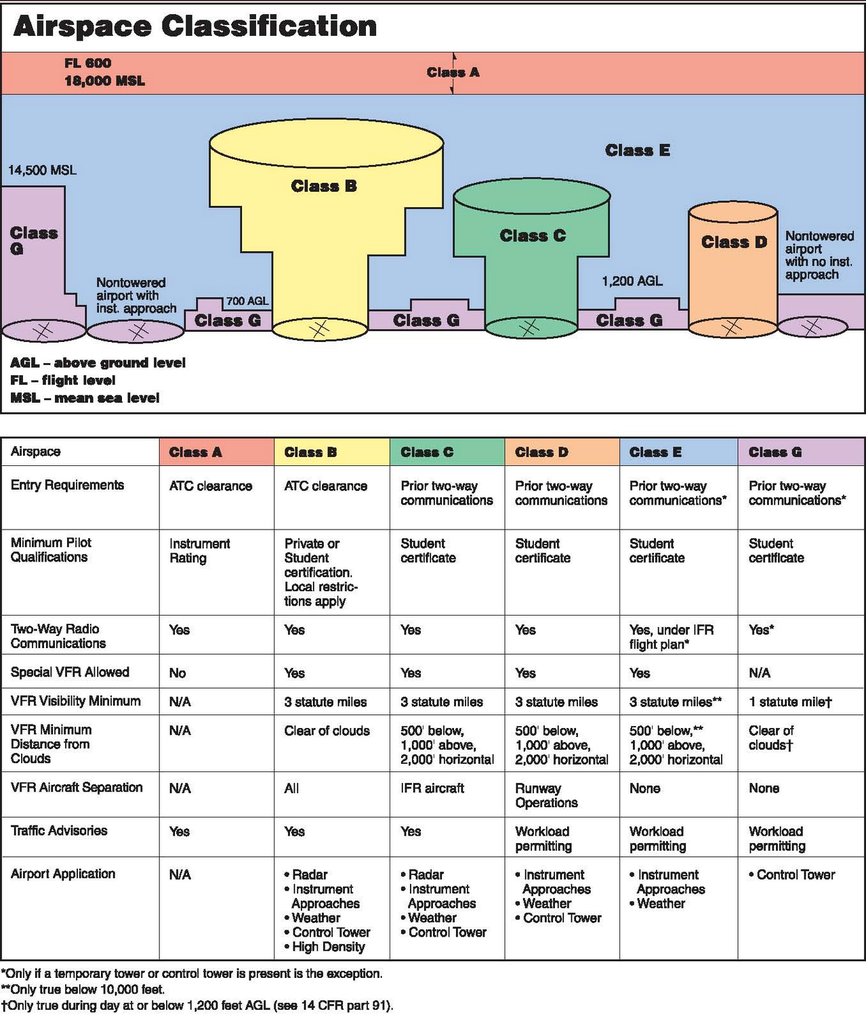
Airspace in the United States is tiered according to operational complexity, traffic density, and air traffic control (ATC) capabilities. Understanding the shape, boundaries, and equipment demands of each class is essential for both manned aircraft navigation and unmanned aircraft system (UAS) mission planning.
- Class A: High-altitude en route airspace extending from 18,000 feet Mean Sea Level (MSL) up to and including Flight Level (FL) 600. All operations must be conducted under Instrument Flight Rules (IFR) with an ATC clearance.
- Class B: Surrounds the nation's busiest commercial hub airports. Structurally shaped like an inverted wedding cake, it typically extends from the surface up to 10,000 feet MSL. Requires explicit ATC clearance ("cleared to enter Class B airspace") and a Mode C / ADS-B Out transponder.
- Class C: Surrounds medium-density airports with operational control towers and radar services. Typically consists of a 5 NM inner surface core (Surface to 4,000 feet AGL) and a 10 NM outer shelf (1,200 feet to 4,000 feet AGL). Requires establishing two-way radio communication before entry.
- Class D: Surrounds smaller regional airports with functioning control towers. Typically a single cylinder from the surface up to 2,500 feet AGL with a 4 NM radius. Requires establishing two-way radio communication prior to entering.
- Class E: Controlled airspace that fills the gaps between terminal environments and high-altitude Class A airspace. Begins at the surface, 700 feet AGL, or 1,200 feet AGL depending on sectional chart designations, extending up to 17,999 feet MSL.
- Class G: Uncontrolled airspace where ATC does not exercise authority over VFR traffic. Extends from the surface up to the base of overlying Class E airspace.
Official FAA publications for detailed regulations, airspace directives, and navigation chart legends.
Basic VFR Weather Minimums
VFR pilots must maintain minimum flight visibility and cloud clearance distances to avoid spatial disorientation and prevent midair collisions with IFR traffic breaking out of cloud layers:
-
Class B VFR Minimums:
3 Statute Miles (SM) flight visibility and Clear of Clouds. This relaxed cloud distance rule accounts for mandatory positive radar separation provided by ATC.
-
Class C & Class D Minimums:
3 SM flight visibility and standard cloud distance of 500 feet below, 1,000 feet above, and 2,000 feet horizontal (commonly remembered as 3 - 152s).
-
Class E (Below 10,000' MSL):
3 SM flight visibility and 500 feet below, 1,000 feet above, and 2,000 feet horizontal cloud clearance.
-
Class E (At or Above 10,000' MSL) & Class G High Altitude:
5 SM flight visibility and 1,000 feet below, 1,000 feet above, and 1 SM horizontal cloud clearance due to higher aircraft closure speeds.
Airspace Characteristics & Dimensions Reference Matrix
| Airspace Class | Sectional Chart Marking | Vertical Boundaries / Altitudes | Lateral Dimensions / Diameter | Entry & Communication Requirement | Key Avionics Required |
|---|---|---|---|---|---|
| Class A | Not depicted (assumed above 18,000' MSL) | 18,000' MSL up to FL600 (approx. 60,000' MSL) | Overlying the 48 contiguous US & Alaska | ATC Clearance required (IFR Flight Plan only) | Mode C / ADS-B Out, IFR Instruments |
| Class B | Solid blue lines | Surface up to 10,000' MSL (tiered custom shelves) | Custom multi-tiered layout; typically 20 to 30 NM diameter | Explicit ATC Clearance ("Cleared to enter Class B") | Two-way Radio, Mode C Transponder, ADS-B Out |
| Class C | Solid magenta lines | Surface to 4,000' AGL (Shelf: 1,200' to 4,000' AGL) | Inner core: 10 NM diameter (5 NM radius); Outer shelf: 20 NM diameter (10 NM radius) | Establish 2-way communication (ATC calls your full callsign) | Two-way Radio, Mode C Transponder, ADS-B Out |
| Class D | Dashed blue lines | Surface up to 2,500' AGL (individually tailored) | Typically 8 NM diameter (4 NM radius core) | Establish 2-way communication prior to boundary entry | Two-way Radio required |
| Class E | Dashed magenta lines (surface), shaded magenta (700' AGL floor), or shaded blue (1,200' AGL floor) | Surface, 700' AGL, or 1,200' AGL up to 17,999' MSL | Fills non-terminal gaps nationwide; vector transitions | None for VFR; ATC clearance for IFR operations | Mode C / ADS-B Out required above 10,000' MSL |
| Class G | Not explicitly lined (area outside shaded magenta/blue boundaries) | Surface up to base of overlying Class E (700' or 1,200' AGL) | Uncontrolled regions outside controlled airspace boundaries | None required for VFR or Part 107 operations | None required for standard visual operations |
FAA Test Practice Questions
Question: What minimum radio equipment is required to enter Class C Airspace?
Options:
(A) Transponder only.
(B) Two-way radio communications equipment and a 4096-code transponder with encoding altimeter (and ADS-B Out).
(C) Two-way radio communications equipment only.
Correct Answer: (B) — Entry into Class C requires two-way radio contact plus a Mode C transponder and ADS-B Out equipment within and above the ceiling bounds.
Question: With respect to entry requirements, what must a VFR pilot receive prior to entering Class B airspace?
Options:
(A) A discrete transponder code only.
(B) Acknowledgement of the aircraft's callsign by the controller.
(C) Explicit ATC clearance stating "Cleared to enter Class B airspace."
Correct Answer: (C) — Unlike Class C or D where establishing two-way dialogue is sufficient, Class B requires the explicit phrase "cleared to enter Class B airspace."
Question: What are the basic VFR weather minimums in Class D airspace below 10,000 feet MSL?
Options:
(A) 3 SM visibility, 500' below, 1,000' above, 2,000' horizontal.
(B) 1 SM visibility, clear of clouds.
(C) 5 SM visibility, 1,000' below, 1,000' above, 1 SM horizontal.
Correct Answer: (A) — Standard Class D weather minimums are 3 statute miles flight visibility and cloud clearance of 500 feet below, 1,000 feet above, and 2,000 feet horizontal.
Additional Pilot Study Guides
-
Sectional Chart Symbols:
Guide to interpreting magenta vs. blue dashed boundaries, Mode C rings, and Restricted/Prohibited airspace shading.
-
Part 107 Airspace Authorizations:
How remote pilots request airspace access through LAANC (Low Altitude Authorization and Notification Capability) portals.
-
Special Use Airspace (SUA):
Key operational differences between Prohibited, Restricted, Warning, MOA, Alert, and Controlled Firing Areas.